
 Camera Tripods
"Camera tripods? Come on, do I really need one? I mean, really, hardly anyone uses them."
Good question. And you're right. It is relatively rare to see camera tripods being used, especially on a waterfall hike.
Let me ask you a question.
Do you want to be "anyone", the average picture taker with the average waterfall pictures? Well, you're reading this so I think the answer is a resounding
NO!
Whew! I'm glad we're past that. No losers here. Make up your mind to succeed and you will.For great waterfall pictures, camera tripods are essential. Not handy, not "good to have", not optional, but essential. Here's why.
In order to get the smooth, silky, cotton candy-type look of many professional waterfall photos, a long shutter speed is required. And during the time that the shutter is open, the camera must be perfectly still. Any shake or movement of the camera will result in a blurry and unusable picture.What shutter speeds can be used before a tripod is needed?
The rule of thumb is that you can hand hold down to 1/(focal length). For example, if you are using a zoom lens at 50 mm focal length, you can use a shutter speed of 1/50th of a second or higher.
Naturally, you can extend that range by propping your camera on something, bracing yourself, or by using image stabilization if available on your lens or camera. But the bottom line is that you will need a camera tripod in most situations.
How slow should the shutter speed be for that silky-smooth look?
It varies with each waterfall, mostly on the flow of water. And it's also a matter of personal preference. In general, smaller waterfalls with low flow will look best with very long shutter speeds, say around 1 sec. or longer, while very large waterfalls look best when the water is "frozen" in motion with a very short shutter speed of 1/250th sec. or thereabouts.
For example, the picture in the website logo had a shutter speed of 0.8 seconds.
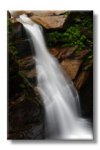 The picture to the right as seen on the home page had a shutter speed of 4.5
seconds.
The picture to the right as seen on the home page had a shutter speed of 4.5
seconds.
Also keep in mind that any trees or other foliage in the picture will also blur with longer shutter speeds if it is windy.
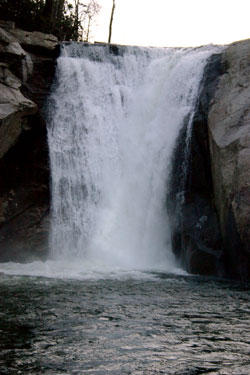
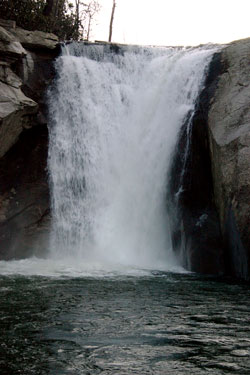
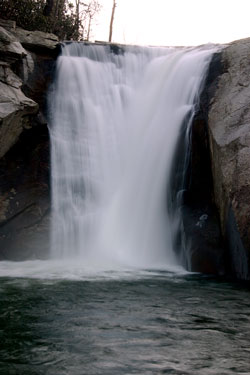
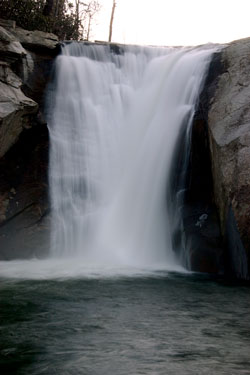
Here is a recent case study. This is a series of photos I took of Elk Falls, also known as Big Falls, along the TN/NC border. The only difference in the pictures is the shutter speed. (ok, I changed the film speed setting up to ISO-400 to get a faster shutter speed at the high end). These aren't great photos but they do illustrate the benefits of camera tripods in waterfall photography and you can clearly see the impact of the various shutter speeds.
 |
 |
|
1/125 sec |
1/60 sec |
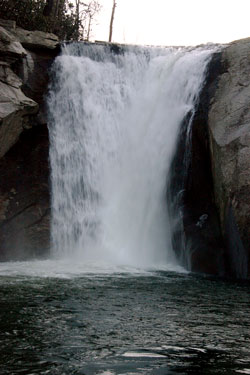 |
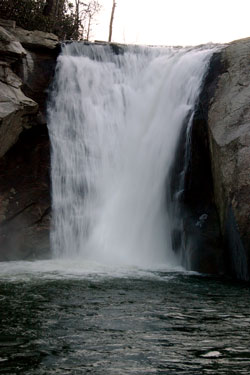 |
|
1/30 sec |
1/15 sec |
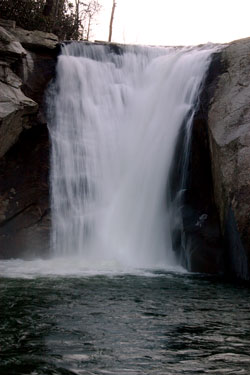 |
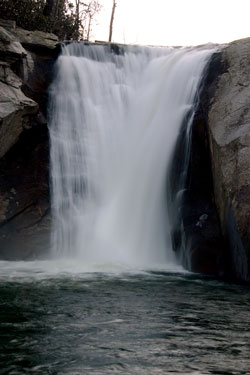 |
|
1/8 sec |
1/4 sec |
 |
 |
|
1/2 sec |
1 sec |
Another example of a "low flow" waterfall will be posted soon.
I can already hear your next question.
What kind of tripod do I need?
The answer is simple. Buy the best tripod you can afford.
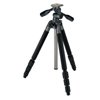
Yes, you also need to look at tripod reviews and decide your primary use for the camera tripod. If you will be backpacking or taking long day hikes, weight and size become big factors. If you normally only photograph within a mile or two of the car then you can look at heavier camera tripods. A good head on the tripod is also very important. Many people may disagree with me but for most purposes a solid 3-way pan-and-tilt head is fine for waterfall photography.I recently upgraded to a carbon fiber tripod with a magnesium 3-way head, the Hakuba HG-504MX. Let me just say, I love this tripod. For me it was a great compromise between price and features, although I didn't have to give up much on the features.
| FREE TIP: If you get a tripod without any leg padding, you can easily make your own padding from insulation. Buy some of the black 1", closed cell, polyurethane insulation that is used on air conditioner lines. Cut one side of it lengthwise so you can slide it onto the tripod leg and then wrap it with some electrical tape. It works like a charm. I did this on my previous tripod and it lasted for many years. |
Other Tripod Benefits
Using a tripod forces you to slow down. This is good. In fact you need to take your time. Compose the picture, don't just snap it. Look for the right composition. Try different zoom levels. Switch from landscape to portrait. Bracket the shutter speeds. Apply the Rule of Thirds if appropriate. The tripod helps you focus on getting the right composition.
Camera tripods are also helpful when you have a lot of contrast in the picture. And waterfall pictures are notorious for this. The water is typically bright while the rocks and/or foliage is dark. With a tripod you can take two pictures with the exact same composition. For one picture you expose properly for the light areas and for the second you expose properly for the dark areas. You can then overlay these photos using software like Photoshop and obtain an evenly exposed waterfall photo. A tutorial on this process is on the way.
Bottom Line? Get a tripod.
Return to top of Camera Tripods

New! Comments
Have your say about what you just read! Leave me a comment in the box below.